
Corporate communication tells people why you do what you do. Aligning people and employees around values builds relationships. You create advocates and attract/keep strong talent.
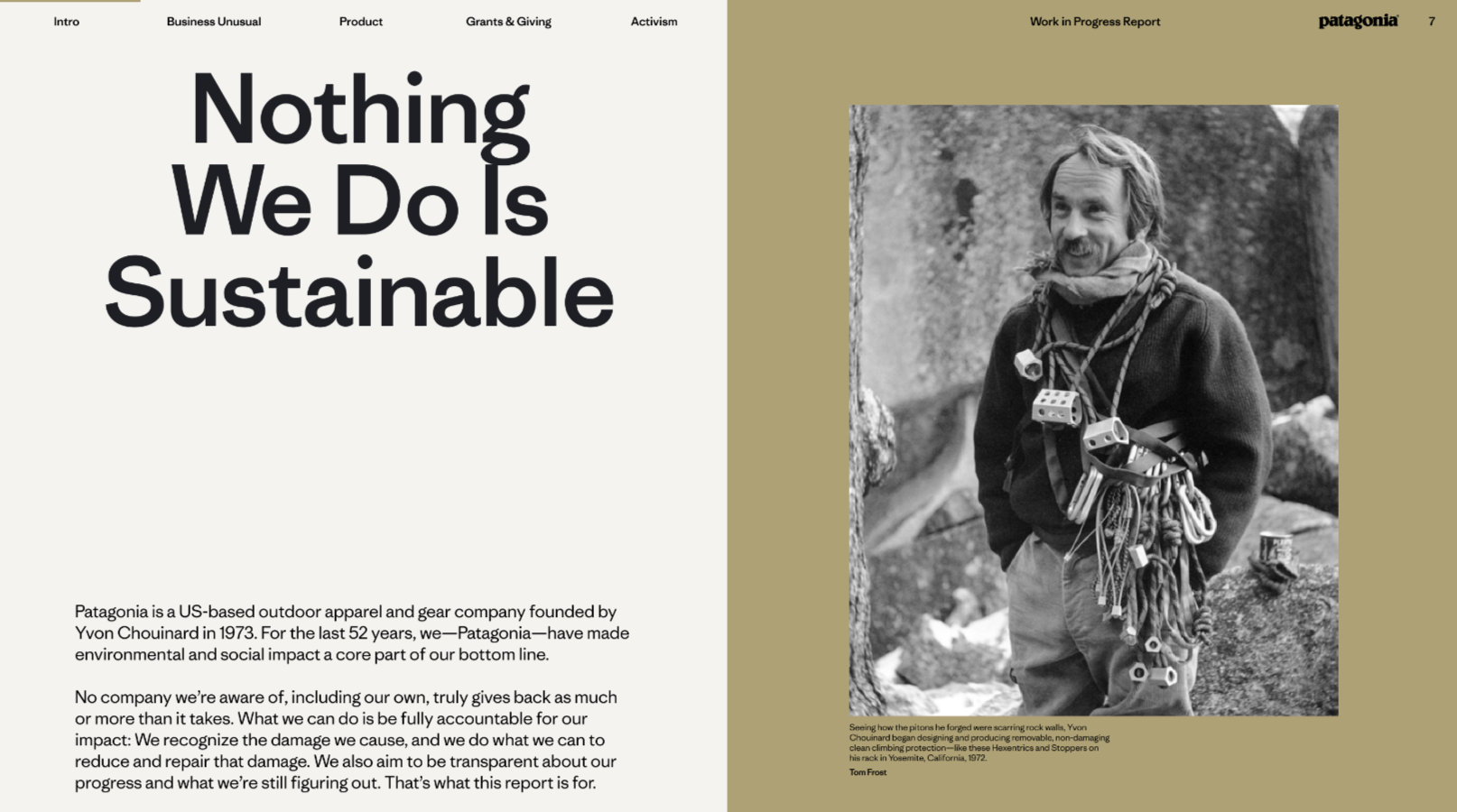
Patagonia set out to produce its first annual impact report. They wanted it to align with global reporting standards, yet still reflect the company’s distinct values and voice. The challenge was to meet formal disclosure expectations without losing the candor and clarity that define Patagonia’s communication.
Working with internal teams, I created a narrative grounded in plainspoken language, transparency and education. The narrative structure and copy clarified why Patagonia takes certain positions, what it measures, and how it evaluates progress—blending standards-based reporting together with the company’s unique, values-led philosophy.
 Read the Report
KEEN is a leader in the footwear industry. In 2019, their shoes became 95% free of perfluorinated chemicals (PFCs), a common substance used for waterproofing gear. They didn't do it for the credit: they want to eliminate "forever chemicals" in their supply chain because it was the right thing to do.
But they also wanted to share their learnings and encourage other companies to look at their own supply chain. How could they create transparency and share what they learned?
Working with a team of ESG (Environmental, Social, and Governance) and supply chain experts, we hammered out a green guide that outlines how KEEN got to 95% PFC-free.
We also wrote KEEN's first Impact Report by building content around three main pillars — Access & Inclusion, Detox the Planet, Disaster Relief — and digging up all the KPIs we could find to show how KEEN was working toward and measuring their environmental and social impact.
IKEA had ambitious environmental and social goals, but communication varied across markets and functions. Much of the language was technical or abstract, making it difficult for co-workers and customers to see how responsible sourcing, product design and home life connected in practical terms.
Working with a global communication team in Älmhult, Sweden, we developed a shared platform that translated strategy into clear, relatable language and examples. The work linked IKEA’s vision of "creating a better everyday life for the many people" to tangible actions, helping shift communication from broad commitments to everyday relevance.

IKEA was ready to launch a major sustainability initiative promoted in owned, earned, and paid channels, but their most important audience was the company's 130,000 co-workers in 36 countries. How could they educate everyone in their organization — from C suite execs to warehouse workers — about the huge changes that were about to happen and get them involved?
Working with IKEA sustainability communication managers, we developed monthly inhouse communication tools that were shared in digital newsrooms, newsletters, and Yammer forums. We highlighted ongoing progress, challenges and success stories so every IKEA co-worker could feel they had a direct impact on this new, multi-year global initiative.

One Home One Planet (OHOP) is an IKEA event that brings together purpose-driven, business leaders and government institutions from around the world. The goal is to break down barriers and solve key social and environmental challenges.
IKEA wanted this event, which focused on the refugee crisis, to be focused, action-oriented and easily shareable. How could they capture it so anyone in the world could hear directly from leaders and refugees; then become part of the solution?
I attended the OHOP 2022 event virtually and captured key concepts for a very succinct Output Report that is available online for anyone who wants to read more about the global refugee program.
The report includes a global call-to-action from Filippo Grandi, UN High Commissioner for Refugees. There's also a QR code that links to a Skills for Employment Toolkit, which is a how-to guide for opening pathways for refugees.
The ultimate goal? Creating decent work for refugees who are trying to create better lives for themselves and their families.
